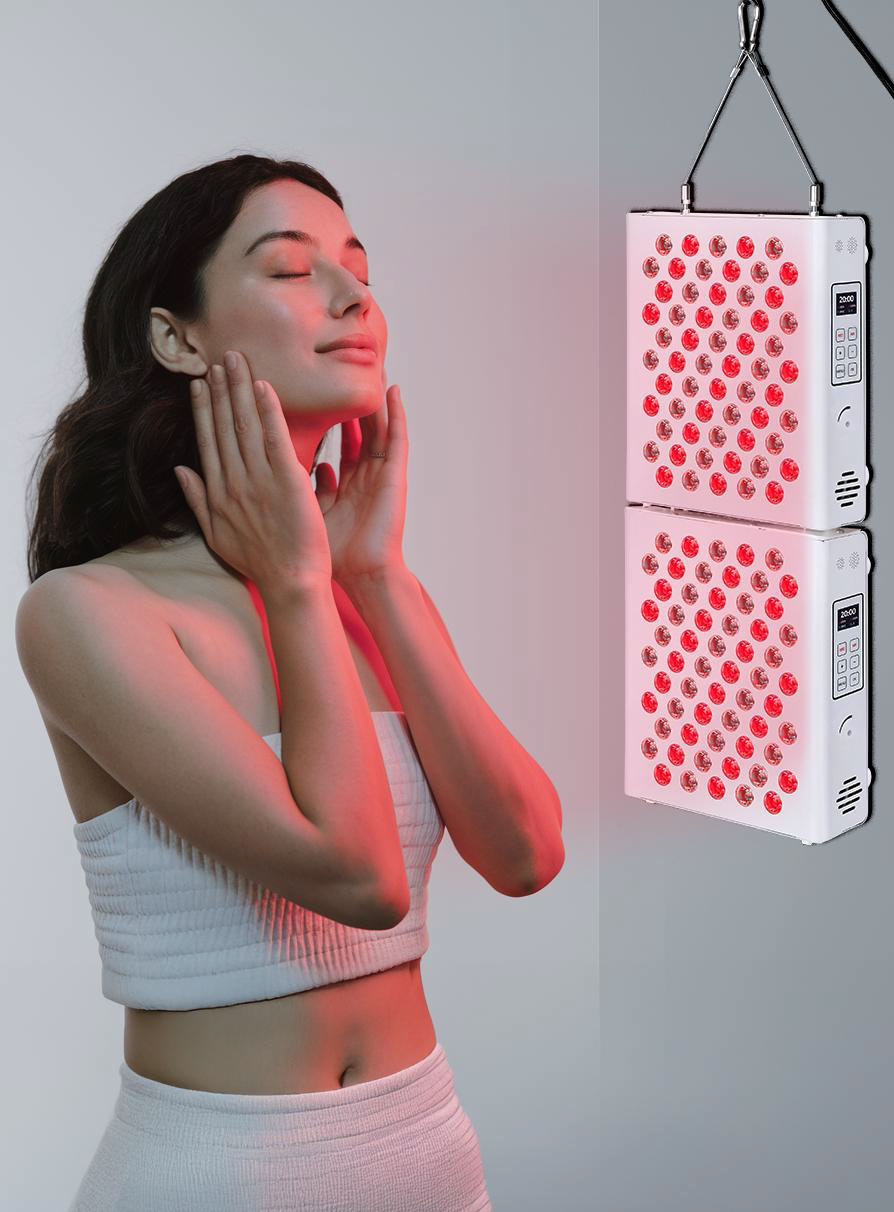
What is Redlight Therapy
So, what is Redlight Therapy (NIR)?
Well, you are in the right place, we are the one-stop shop. Servicing Salons, Gyms, Resorts, with NiR beds, portable devices and masks, and serums at factory prices. So, here we please enjoy the read, we will update with the technology and new product in our Blogs.
Red and Near Infrared Light Therapy?
Red and near-infrared light therapy is one of the biggest breakthrough discoveries in health over the past century. Over the past few decades, scientists have amassed thousands of studies on the power of red and near-infrared light to enhance human health.
Red and near-infrared light are those parts of the electromagnetic spectrum, and more specifically, the sunlight spectrum, that favour plant and animal growth.
FIND OUT MORE
History of phototherapy technology
Red light therapy began in 1903, and its inventor, Niels Finsen, won the Nobel Prize in Medicine for it. 1960s: It began to be applied to the treatment of chronic pain, arthritis, joint rehabilitation and soft tissue damage; 1980s: Humans discovered infrared therapy, which began to be applied to wound healing and health beauty; 1990s: People discovered red Light therapy has a significant role in promoting sports trauma tissue repair. Entering the 21st century: red light, blue light, and infrared light therapy have a large amount of mature data, and are widely used in skin diseases, pain treatment, medical beauty and other fields, and have received strong support from many medical experts and groups.
Scientific Research on Red Light Therapy The principle of red light: Red light can penetrate human tissue, and about 80% of the energy is absorbed in the first 2cm. Red light energy has a significant impact on the stimulation of mitochondria. Mitochondria are tiny organelles that are the energy powerhouses of all the cells in our body. Red light therapy helps the mitochondria to produce more ATP (adenosine triphosphate), a complex organic chemical that powers processes in cells such as muscles Contraction, transmission of nerve impulses, and chemical syntheses are present in all life forms.
ATP is often referred to as the "molecular currency unit" of energy transfer in cells. When our cells get more energy, they can perform more vigorously. ATP can also promote cell cycle regeneration, enhance the discharge of harmful toxins and anti-inflammation ability, the health status will improve accordingly.
The principle of near infrared light:
Near-infrared light can penetrate deeper skin tissue, and about 50% of near-infrared light can. penetrate to 8cm, and the deepest can reach 20cm (data from NASA research). Near-infrared energy heats tissue and is well-documented for use in pain therapy. Near-infrared light will stimulate the Nak+ pump, thereby increasing the permeability of the cell membrane, promoting. the pH balance of the cell, increasing nutrient absorption and eliminating metabolic by-products, and has been widely used in the field of health and beauty.
The benefits of red light: The wavelength of red light is between 600-700 nanometres, which can adjust the texture and tone of the skin, smooth fine lines and wrinkles, promote the production of collagen, regenerate skin tissue and hair, and restore cell vitality , enhance the ability to expel harmful toxins and anti-inflammation.
The benefits of near-infrared light: Near-infrared light has a wavelength between 700-1100 nanometres, which can penetrate skin tissue, promote wound healing, relieve muscle soreness, nerve damage and joint pain by accelerating the decomposition of lactic acid. When used in combination, red and infrared light increase the biological effect and promote the synthesis of collagen and elastin fibres.